By Kim Xi Harris
Founder & CEO, Lex Arca Legal Vault | https://calculator.lex-arca.com
More than 300 standing court orders now govern how attorneys use AI in active litigation — and almost none of them address only hallucinated citations. A growing number specifically address data handling, inference architecture, and whether privileged material transited infrastructure outside the attorney’s control. If your AI tool processes documents on servers you do not own, that question now has case-dispositive implications.
Where Does the AI Actually Process Your Privileged Documents?
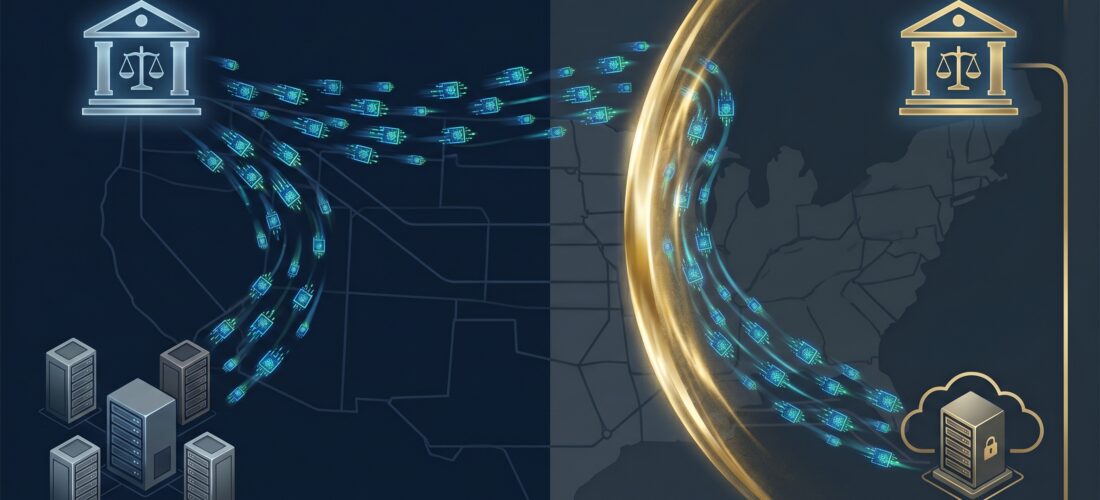
Every time a legal AI tool summarizes a deposition, surfaces a contradiction, or generates a damages analysis, inference is happening somewhere. Most platforms on the market today run that processing on shared cloud infrastructure the law firm does not own. The vendor encrypts the data. What the vendor cannot tell you is that your privileged work product never left your control while the AI was working with it.
That distinction matters. ABA Formal Opinion 512 does not address cloud architecture by name — but it squarely applies Model Rule 1.6 confidentiality obligations to any AI tool an attorney uses. When privileged material transits a third-party inference server, a motion to challenge attorney-client privilege has architectural support that is difficult to overcome.
“Every major cloud-based legal AI platform can tell you your data is encrypted. Very few can tell you your data never left your environment while the AI was processing it. Those are different claims.”
What Do Standing Court Orders Actually Require Regarding AI Data Handling?
Of the 300+ standing court orders on AI-assisted filings as of 2026 — a figure that grew by more than 200 orders in the second half of 2025 alone — a significant and increasing number require attorneys to disclose not just that AI was used, but how it was used and where the underlying data was processed. Florida’s Administrative Order 26-04 requires personal attorney certification on AI-assisted filings. Several federal district courts require attorneys to confirm that AI output was personally reviewed and that the AI tool complied with the court’s data handling requirements.
An attorney who cannot answer ‘where does your AI actually run?’ is not positioned to make that certification with confidence. An attorney using a local-first platform can answer it precisely.
How Does Lex Arca’s Local-First Architecture Address This Exposure?
Lex Arca’s Local-First Architecture is an architectural decision, not a marketing phrase. The Neural Librarian analyzes your documents inside the Lex Arca vault — your firm’s private, controlled environment. When you query the Neural Strategist, inference happens within your vault’s compute layer. Your prompt does not leave your environment. Your documents do not leave your environment. The AI Compliance Certification generated by Neural Sentinel’s four-step workflow documents precisely this: where the inference occurred, under what jurisdictional rules, and what attorney review was applied.
Before any AI output reaches the attorney, Neural Sentinel runs a jurisdictional gate — checking the applicable standing court orders, state bar AI disclosure requirements, and ABA Opinion 512 obligations. It flags where personal attorney certification is required and produces a Verification Attestation certificate aligned with those requirements. The documented activity trail underneath every interaction is append-only, tamper-evident, and cryptographically timestamped.
What Happens When Opposing Counsel Challenges Your Evidence Integrity?
In active litigation, evidence integrity is not just a security question — it is a foundation question. When opposing counsel challenges whether a document was modified between collection and production, you need more than a vendor’s assurance. You need a documented activity trail showing every access event, modification, and export, logged by user identity and document version.
Lex Arca’s documented activity trail provides exactly that. Every interaction with every piece of evidence in the vault is recorded with the user identity, timestamp, and document version in a log designed to resist retroactive alteration. When the challenge comes, you produce the record — documented and verifiable, not just asserted.
Attorneys who suffered the most high-profile AI sanctions in recent history — including the $86,000 sanctions issued against a Florida attorney and the three-attorney disqualification at a 350-person firm for AI-fabricated citations — were not using platforms built around a compliance architecture. They were using general-purpose AI tools that had no jurisdictional gate, no verification attestation, and no documented activity trail. Lex Arca was built so that outcome is structurally prevented.
“The AI sanctions cases of 2025 and 2026 did not happen because attorneys were careless. They happened because the tools had no compliance architecture. Lex Arca’s Neural Sentinel is that architecture.”
Key Takeaways
1. More than 300 standing court orders govern AI use in active litigation, with a growing number addressing data handling and inference architecture — not just citation accuracy.
2. Most legal AI platforms on the market process privileged documents on cloud infrastructure outside the attorney’s control, creating potential exposure under ABA Model Rule 1.6 and standing court certification requirements.
3. Attorneys operating in jurisdictions with AI disclosure mandates should be prepared to certify precisely where their AI tool processes data — a question that local-first architecture answers definitively.
4. Lex Arca Legal Vault provides a local-first private vault, Neural Sentinel jurisdictional gate, and append-only, tamper-evident documented activity trail designed to support attorney compliance workflows.
5. Calculate your firm’s compliance exposure and get early access at https://calculator.lex-arca.com.
→ Calculate Your Billing Leakage + Join the Founding Firms VIP Waitlist
About the Author
Kim Xi Harris is the Founder and CEO of Lex Arca Legal Vault, an AI-native litigation intelligence and compliance platform for solo and small-firm attorneys. She is a Cornell Women’s Entrepreneur Program graduate, SBA Women in Business Champion Award recipient, WOSB certified, and holds five Google AI certifications. Calculate your firm’s billing leakage and join the VIP waitlist at https://calculator.lex-arca.com — or reach us at legalvault@lex-arca.com.