By Kim Xi Harris
Founder & CEO, Lex Arca Legal Vault | Check your billing leakage https://calculator.lex-arca.com
Billing disputes in AI-integrated practices have a new dimension that most attorneys have not yet confronted: the client no longer just questions whether the time was reasonable — they can now question whether the AI-assisted work was billable at all, whether it was disclosed, and whether the documentation supports the entry under ABA Formal Opinion 512’s reasonableness requirements. When that dispute reaches a state bar fee arbitration panel, the attorney who can produce a cryptographically timestamped documented activity trail is in a categorically different position than the attorney who cannot.
What Does ABA Formal Opinion 512 Require Specifically About AI-Assisted Billing?
ABA Formal Opinion 512 addresses billing directly under Model Rule 1.5, which requires that attorney fees be reasonable. The Opinion makes clear that when AI reduces the time required to complete a task that would previously have required significant attorney or paralegal hours, the firm may not bill for the time the task would have taken without AI — only for the time it actually took. The corollary obligation: the attorney must be able to document what the AI actually did, how long the human review took, and why the resulting billing entry is reasonable under the circumstances.
That documentation obligation is not hypothetical. The DOJ attorney terminated in March 2026 for fabricated citations was flagged in part because there was no documented review trail showing that a human had verified the AI output before filing. The $86,000 sanctions issued to a Florida attorney for AI hallucinations in court filings included a finding that the attorney lacked any documented review process. In both cases, the absence of a documented activity trail was not a minor procedural gap — it was central to the adverse outcome.
“The billing dispute of 2026 is not ‘did you work 18 minutes or 12.’ It is ‘what did your AI do, did you review it, and can you prove it?’ The Neural Hash answers all three.”
How Does Neural Billing Create Documentation That Satisfies the ABA Opinion 512 Standard?
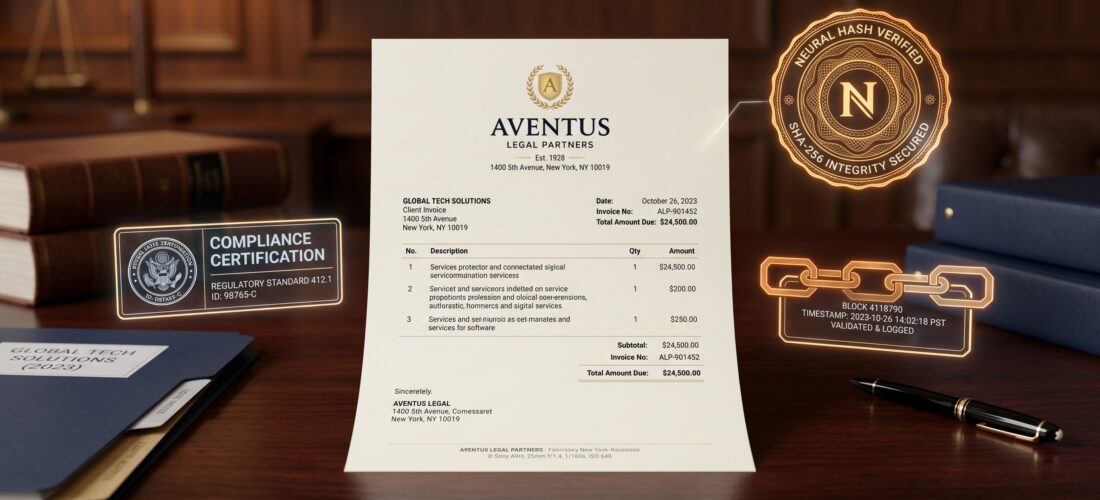
Lex Arca’s Neural Billing captures work at the source — the moment a client file is opened inside the vault, the system begins logging activity automatically. No timer to start. No manual entry to reconstruct at end of day. Every logged minute is backed by a Neural Hash: a cryptographic, time-stamped record that ties the billing entry to the exact file, the exact document accessed, and the exact duration of the session.
This is not a note that says ‘reviewed deposition.’ It is a documented entry showing this specific user had this specific document open from timestamp A to timestamp B, with the Neural Hash verifying the record has not been altered since it was created. For AI-assisted work specifically, the Neural Sentinel compliance layer attaches a Verification Attestation to every substantive AI output — creating a documented record of what the AI generated, when, under what jurisdictional rules, and what attorney review was applied before use. The billing entry and the compliance certification are linked in the same append-only documented activity trail.
What Happens in a Fee Arbitration When You Can Produce the Neural Hash Record?
Fee arbitration panels and state bar investigators reviewing billing disputes are increasingly sophisticated about AI. They know the tools exist. They know the time compression is real. What they are looking for is documentation: was the work actually done, did a human review the AI output, was the time billed consistent with what actually occurred, and is the billing entry supported by something other than the attorney’s recollection?
When you produce a Neural Hash record in that context, the conversation shifts. You are not asserting the work was done — you are demonstrating it. The cryptographically timestamped activity log shows the file access, the document opened, the session duration, and the AI compliance certification attached to the output that was reviewed. The dispute does not require you to convince the panel. The record does it for you.
For institutional clients — corporate legal departments, insurance carriers, and high-net-worth individuals who routinely audit outside counsel billing — the ability to produce this documentation on demand is not just a dispute resolution tool. It is a client retention differentiator. Firms that can walk an in-house general counsel through a Neural Hash audit trail on any billing entry, on request, are operating at a standard that most outside counsel cannot match.
How Does Dual-Export Invoicing Complete the Compliance Workflow?
When a matter closes inside Lex Arca, a single click generates two simultaneous outputs: a polished, professional PDF invoice formatted for the client, and a structured data file that integrates directly with your accounting software. The Neural Hash documented activity trail underlies every line item. No double entry, no manual reconciliation, and no end-of-month reconstruction from memory.
For attorneys subject to client audit rights — common in corporate representation engagements — this means every invoice is audit-ready from the moment it is generated. The client does not need to request documentation. The documentation is already built into the billing workflow. That is not a billing feature. It is a professional responsibility infrastructure — one that satisfies ABA Opinion 512’s reasonableness documentation standard before the client ever asks the question.
“Your invoice does not just need to be accurate in 2026. It needs to be documented and verifiable — and the documentation needs to cover both the time and the AI that assisted it.”
Key Takeaways
1. ABA Formal Opinion 512’s Model Rule 1.5 reasonableness standard requires attorneys to document AI-assisted billing entries with enough specificity to demonstrate that billed time reflects actual human review — not just AI output time.
2. Recent AI sanctions cases, including a DOJ termination and $86,000 Florida sanction, involved findings that attorneys lacked any documented review process — making the billing documentation gap a professional responsibility issue, not just a revenue issue.
3. Neural Billing’s Neural Hash creates a cryptographically timestamped documented activity trail tying every billing entry to the exact file, document, and session duration — supporting fee arbitration and state bar inquiries on demand.
4. Lex Arca Legal Vault links Neural Billing’s documented activity trail to Neural Sentinel’s AI Compliance Certification, creating a unified billing and compliance record for every AI-assisted matter.
5. Calculate your firm’s billing leakage and get early access at https://calculator.lex-arca.com.
→ Calculate Your Billing Leakage + Join the Founding Firms VIP Waitlist
About the Author
Kim Xi Harris is the Founder and CEO of Lex Arca Legal Vault, an AI-native litigation intelligence and compliance platform for solo and small-firm attorneys. She is a Cornell Women’s Entrepreneur Program graduate, SBA Women in Business Champion Award recipient, WOSB certified, and holds five Google AI certifications. Calculate your firm’s billing leakage and join the VIP waitlist at https://calculator.lex-arca.com — or reach us at legalvault@lex-arca.com.

What Does a Purpose-Built AI Litigation Platform Actually Look Like — And Why Does the Difference Matter for Your Bar Compliance?
Repurposed from Newsletter 09 | Lex Arca Legal Vault | legalvault@lex-arca.com
By Kim Xi Harris
Founder & CEO, Lex Arca Legal Vault | https://calculator.lex-arca.com
The legal technology market in 2026 is saturated with AI tools that were built for general business use and retrofitted for legal purposes. The document storage platform was built for marketing teams. The billing software was built for consultants. The research tool was built for academics. The compliance obligation that ABA Formal Opinion 512 imposes — specifically, that attorneys maintain a reasonable understanding of every AI tool used in their practice — applies to all of them. For an attorney running a patchwork stack of retrofitted tools, that obligation is structurally unmanageable. For an attorney running a purpose-built litigation platform, it is designed into the workflow.
What Is the Difference Between a Retrofitted Legal AI Tool and a Purpose-Built Litigation Platform?
A retrofitted tool is one designed for a different use case — document collaboration, general business billing, academic research — that has been adapted for legal use through added features or branded positioning. The underlying architecture was not built for the courtroom, for evidence integrity requirements, for the attorney-client privilege obligations of legal confidentiality, or for the personal verification workflow that ABA Opinion 512 requires.
A purpose-built litigation platform is designed from the ground up for the highest-pressure moments of legal practice. Document retrieval built for the beat between a witness’s answer and your follow-up — not the patience of a library search. Billing capture designed for the reality of an attorney’s interrupted workflow — not the discipline of a timekeeper who remembers to click start. Security architecture built to the standard of legal confidentiality — not the convenience of a shared cloud folder. And critically: a compliance layer built into every function, not added as an afterthought to satisfy a vendor checklist.
“ABA Opinion 512 requires attorneys to maintain a reasonable understanding of every AI tool used in their practice. Understanding five retrofitted tools from five different vendors, each with its own data handling policy, is not reasonable. It is impossible.”
How Does Neural Sentinel Make Compliance Manageable Across Every Platform Function?
Neural Sentinel is the compliance architecture that unifies every function inside Lex Arca. Before any AI-generated output is delivered — whether from the Neural Librarian, the Neural Strategist, or the Case Premise Intelligence Engine — Sentinel runs a four-step compliance workflow: jurisdictional gate checking applicable standing court orders and state bar AI disclosure requirements; AI strategic synthesis generating the analysis; Verification Attestation producing an ABA Opinion 512-aligned compliance certificate; and dual cryptographic logging creating the append-only, tamper-evident documented activity trail.
The result is that the ABA Opinion 512 obligation to understand the AI tool is satisfied not by asking the attorney to study the architecture, but by building a documented record of every AI interaction that is auditable on demand. The attorney does not need to understand the inference mechanics. They need to be able to demonstrate, when asked, that they reviewed the AI output and that a documented compliance record exists for every AI-assisted step of the matter. Neural Sentinel produces that record automatically.
What Does Each Lex Arca Component Replace — and What Compliance Gap Does It Close?
The Neural Librarian replaces generic keyword search and cloud document storage with semantic, context-aware retrieval that understands legal language. Every retrieval event is logged in the documented activity trail. The gap it closes: imprecise retrieval that undermines the attorney’s ability to certify AI-assisted document analysis under Florida AO 26-04 and similar standing court orders.
The Neural Strategist replaces fragmented research tools and manual deposition prep with a case-specific analysis engine that draws directly from the evidence record in the vault. Every analysis runs through Neural Sentinel before delivery. The gap it closes: generic AI output that has not been grounded in the specific case record, creating fabrication risk of the kind that produced the $86,000 Florida sanction and the DOJ termination.
Neural Billing replaces manual timer applications and reconstructive logging with automatic, cryptographically timestamped activity capture. The gap it closes: unverifiable billing entries in AI-integrated practices that cannot survive fee arbitration or state bar ABA Opinion 512 reasonableness review.
The Cinematic HUD replaces third-party trial presentation software with a purpose-built, within-seconds retrieval interface designed specifically for courtroom use. The gap it closes: the hesitation during cross-examination or exhibit presentation that signals to the jury that the attorney is not fully in command of the record.
Why Does Purpose-Built Architecture Matter More as Regulatory Pressure Increases?
The regulatory environment for AI-using attorneys is tightening in a specific direction: courts and state bars are not just sanctioning hallucinated citations anymore. They are beginning to examine the entire workflow — how the AI was used, where the data went, whether the output was reviewed, and whether the attorney can document the process. A retrofitted tool stack does not produce that documentation. A purpose-built platform with a unified compliance architecture does it by default.
Lex Arca’s Founding Firms program offers 50 early-access slots at $5,000/year flat, locked for life. The full platform — Neural Librarian, Neural Strategist, Neural Billing, Neural Sentinel compliance proof chain, and Cinematic HUD — is included from day one. For solo and small-firm attorneys who cannot build a compliance infrastructure from scratch across five separate vendor relationships, this is the architecture that makes ABA Opinion 512 compliance operationally achievable.
“The future of legal practice is not about working harder inside a patchwork of retrofitted tools. It is about being equipped — with a platform where every function was built for the moment your cases demand, and every compliance obligation is documented automatically.”
Key Takeaways
1. ABA Formal Opinion 512 requires attorneys to maintain a reasonable understanding of every AI tool used in their practice — an obligation that is structurally unmanageable across a fragmented stack of retrofitted general-purpose tools.
2. A purpose-built litigation platform integrates the compliance architecture into every function, producing documented activity trails and ABA Opinion 512-aligned Verification Attestation certificates automatically.
3. Neural Sentinel’s four-step compliance proof chain unifies all Lex Arca functions under a single compliance layer — jurisdictional gate, AI synthesis, Verification Attestation, and dual cryptographic logging.
4. Lex Arca Legal Vault is the only litigation intelligence platform designed from the ground up for solo and small-firm attorneys, with compliance infrastructure built into every workflow rather than added as a feature.
5. Calculate your firm’s billing leakage and get early access at https://calculator.lex-arca.com.
→ Calculate Your Billing Leakage + Join the Founding Firms VIP Waitlist
About the Author
Kim Xi Harris is the Founder and CEO of Lex Arca Legal Vault, an AI-native litigation intelligence and compliance platform for solo and small-firm attorneys. She is a Cornell Women’s Entrepreneur Program graduate, SBA Women in Business Champion Award recipient, WOSB certified, and holds five Google AI certifications. Calculate your firm’s billing leakage and join the VIP waitlist at https://calculator.lex-arca.com — or reach us at legalvault@lex-arca.com.