By Kim Xi Harris Founder & Platform Architect, Lex Arca Legal Vault™ | Calculate your firm’s billing leakage | legalvault@lex-arca.com
Florida Administrative Order 26-04, issued January 15, 2026 by the 11th Judicial Circuit in Miami-Dade, requires a specific written certification on every AI-assisted court filing — covering pleadings, motions, memoranda, and proposed orders. Attorneys who used AI in any filing after January 15 and did not include this certification are already out of compliance. Palm Beach County followed. More circuits are watching.
What Does Florida Administrative Order 26-04 Actually Require?
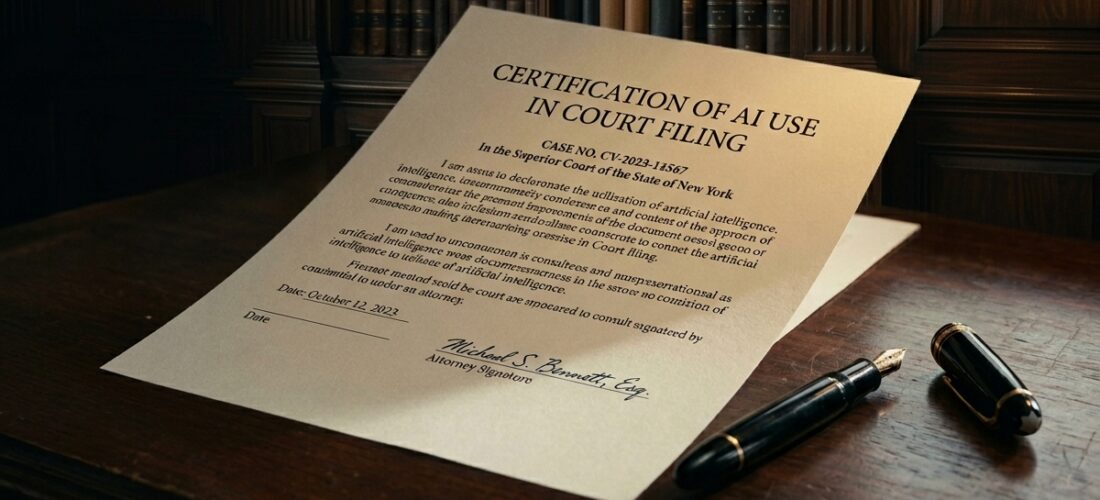
AO 26-04 requires that any attorney who used generative AI in preparing a court filing include a written certification confirming: (1) the filing was prepared with the assistance of AI; (2) all AI-generated content was independently reviewed and verified for accuracy; and (3) any cited authority is real, accurately quoted, and correctly attributed. The order covers attorneys and self-represented litigants alike — and applies to every document filed with the court, not just briefs.
The 17th Judicial Circuit issued a parallel order in the same January window. Palm Beach County followed in April 2026. The Florida Bar has documented both orders and noted that additional circuits are evaluating adoption. The trend line is clear: Florida-based solo and small-firm practitioners face a patchwork of local certification requirements layered on top of state bar obligations and ABA Formal Opinion 512.
What Does ‘Independently Reviewed and Verified’ Mean as an Evidentiary Standard?
‘Independently reviewed and verified’ is not a mental confirmation. It is an evidentiary standard — one that a sanctions motion will test. The attorney must be able to demonstrate, if challenged, that they personally reviewed the AI-generated output, verified each citation against a primary source, and confirmed that quoted language appears verbatim in the cited authority.
The problem for most solo practitioners is not the intention to verify — it is the absence of a documented record proving verification occurred at a specific time before the filing was submitted. A post-hoc explanation that ‘I always verify my citations’ is not a compliance record. A timestamped, append-only verification log that shows the specific AI output reviewed, the verification step taken, and the attorney attestation that preceded submission is a compliance record.
What Is the Sanctions Menu for Non-Compliance Under AO 26-04?
The sanctions menu under AO 26-04 and its parallel circuit orders includes: striking of the non-compliant pleading; monetary sanctions against the attorney; referral for contempt proceedings; and referral to The Florida Bar for disciplinary review. Courts have already demonstrated willingness to use all four categories — including the $86,000 monetary sanction against a Florida attorney documented in prior AI hallucination enforcement actions.
The Alabama Supreme Court added a co-counsel requirement for AI-assisted appellate work, requiring that a licensed Alabama attorney certify review of any AI-generated content before submission. That standard — requiring a second professional signature on the verification record — represents the direction courts are moving, not a ceiling.
How Does Lex Arca’s Compliance Workflow Address AO 26-04 Requirements?
Lex Arca Legal Vault’s four-step compliance proof chain is designed to address exactly the evidentiary standard AO 26-04 establishes. Sentinel checks the jurisdiction before AI synthesis runs — blocking synthesis in NO-GO jurisdictions and logging the gate check. Neural Strategist runs AI synthesis only after Sentinel clears. Verification Attestation generates a filing-ready PDF with the attorney certification language, timestamped and logged. The dual cryptographic logging system captures both the activity log and the Neural Billing ledger — creating an append-only, tamper-evident documented activity trail the attorney can produce in response to a sanctions motion.
For Florida practitioners operating under AO 26-04, the Verification Attestation PDF is formatted to satisfy the certification requirement — and the activity log behind it provides the evidentiary record that ‘independently reviewed and verified’ was not a verbal assertion but a documented workflow step.
Key Takeaways
1. Florida Administrative Order 26-04 (January 2026) requires written attorney certification on every AI-assisted court filing in the 11th Judicial Circuit — with the 17th Circuit and Palm Beach County following.
2. The certification standard requires proof of independent review and verification of all AI-generated content — a mental confirmation does not satisfy the evidentiary requirement.
3. Non-compliance carries a sanctions menu including striking of pleadings, monetary sanctions, contempt referral, and Florida Bar disciplinary referral.
4. Lex Arca Legal Vault™ provides a documented, verifiable AI activity trail designed to support attorney compliance workflows, including filing-ready Verification Attestation PDF generation aligned with AO 26-04.
5. Calculate your firm’s billing leakage and get early access at https://calculator.lex-arca.com.
About the Author
Kim Xi Harris is the Founder and Platform Architect of Lex Arca™, an AI-native litigation intelligence and compliance platform for solo and small-firm attorneys. She is a Cornell Women’s Entrepreneur Program graduate, SBA Women in Business Champion Award recipient, WOSB certified, and holds five Google AI certifications. Calculate your firm’s billing leakage and join the VIP waitlist at https://calculator.lex-arca.com — or reach us at legalvault@lex-arca.com.