By Kim Xi Harris Founder & Platform Architect, Lex Arca™ Legal Vault | Calculate your firm’s billing leakage | legalvault@lex-arca.com
According to Clio’s 2026 Legal Trends Report for Solo and Small Law Firms (May 2026, https://www.clio.com/about/press/2026-solo-small-firm-report/), 71% of solo practitioners and 75% of small firms are now using AI to complete legal work — yet fewer than 33% have seen any revenue increase from it, compared to nearly 60% of enterprise firms. The gap between AI adoption and AI compliance is not a policy problem. It is an architecture problem.
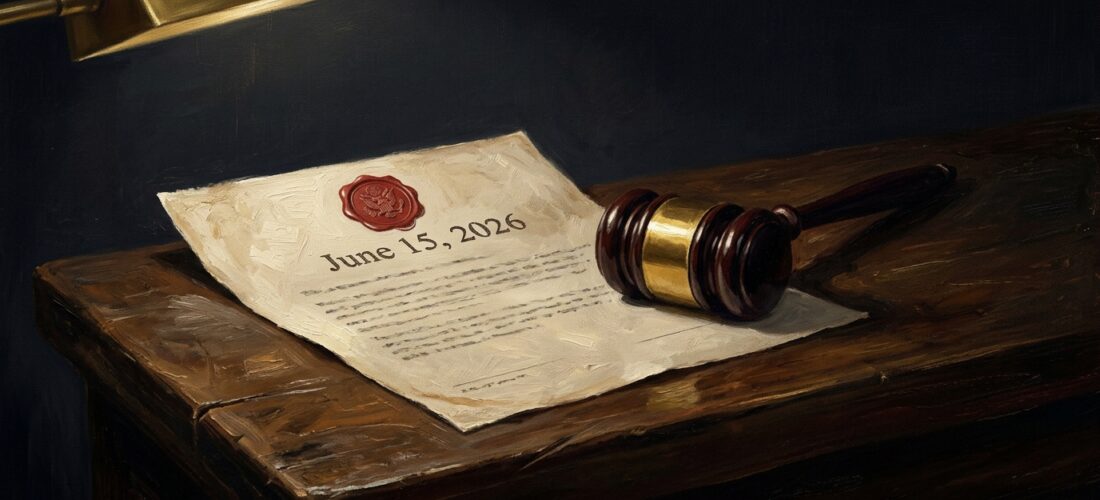
Rule 2.515(d)(2), amended by the Florida Supreme Court in Case No. SC2026-0673 effective June 15, 2026, requires every signer of every filing — attorney or self-represented litigant — to certify that the legal authorities cited “exist and are accurately cited.” The requirement applies to every filing in every Florida court, whether or not AI was involved in producing it. That scope is the entire reason a platform like Lex Arca exists in the first place.
What Does Rule 2.515(d)(2) Actually Require — and Who Does It Apply To?
Rule 2.515(d)(2) requires the signer of any document filed in a Florida court to represent that the legal authorities identified in that filing “exist and are accurately cited” — full stop, with no carve-out for how those authorities were found. An attorney who cited a case by hand that turned out to be overturned, misquoted, or simply wrong carries the same sanctions exposure as an attorney whose AI tool fabricated a citation outright.
The Florida Supreme Court adopted the rule on its own motion in response to a pattern it had observed across its own circuits: AI tools capable of producing “convincing but nonexistent cases, quotations, or legal analysis” had already prompted several circuits, including Palm Beach County, to issue their own local AI disclosure orders. Rather than let that patchwork spread, the court replaced it with one statewide standard, and the companion order AOSC26-12 makes that standard exclusive — no circuit, judge, or local policy may impose a narrower or different requirement.
What Does This Mean for Attorneys Who Don’t Use AI at All?
Attorneys who never use AI are bound by the exact same certification requirement as attorneys who use it constantly — Rule 2.515(d)(2) draws no distinction. The duty to verify cited authorities has always existed under the rules of professional conduct; Florida’s rule simply makes it explicit, statewide, and enforceable with a defined sanctions framework: reprimand, contempt, striking of the document, dismissal of proceedings, costs, or attorneys’ fees, after notice and an opportunity to be heard.
This reframes the question every Florida litigator should be asking. It isn’t “do I use AI enough to worry about this rule.” It’s “can I produce, on demand, a documented record showing every citation in my last filing was verified before submission — regardless of how it was researched.” Most attorneys, AI-using or not, cannot currently answer that with more than “I’m pretty sure I checked it.”
Why Does a Documented Verification Trail Matter More Than the AI Question Itself?
A documented verification trail matters more than whether AI was used, because the rule’s sanctions exposure attaches to inaccurate citations — not to AI use itself. An attorney who manually researched a citation but kept no record of when or how it was verified stands in the identical evidentiary position as an attorney who used AI and kept no record. Both are one challenged citation away from a sanctions motion they cannot defend with anything beyond memory.
This is the gap Lex Arca Legal Vault was built to close — not as an AI compliance feature bolted on, but as the foundational reason the platform exists. The ABA Opinion 512 compliance workflow inside Lex Arca™ creates a documented, verifiable, append-only activity trail for every citation an attorney relies on, whether it surfaced through Neural Librarian’s semantic retrieval, Neural Strategist’s case-grounded analysis, or traditional research. Under a rule that draws no distinction between AI-assisted and manually-researched filings, a platform built the same way is not a coincidence. It is the design.
From Kim’s Chair: The Questions I Would Have Asked
I built Lex Arca™ Legal Vault from the client’s chair — not because I anticipated a specific rule in a specific state, but because I sat in a client’s chair. From that chair, I realized the importance of asking the right questions of the counsel that represented my case because the outcome squarely impacted my life. Florida’s rule didn’t create a risk. It gave it a name, a date, and a sanctions framework. The risk was always there — for every attorney, with or without AI.
If I were in that courtroom as the client, here is what I would ask the room:
- Why did it take a wave of AI-fabricated citations for this profession to formalize a duty that should have always been provable on demand?
- If this requirement has existed in substance under the rules of professional conduct all along, why did it take a statewide rule with a sanctions framework to make attorneys treat it as enforceable?
- How many attorneys in this room could produce, right now, a record of when they last verified a citation they relied on — not from memory, but from an actual timestamped log?
And if I were your client — sitting across from you before you walked into that courtroom — here is what I would have asked you:
- When you tell me you checked a citation, is that something you remember doing, or something you can show me a record of?
- Does it matter to my case whether you found that citation using AI or found it the traditional way — or is the real question simply whether it’s accurate and verified either way?
- If a citation in my filing turned out to be wrong, would I find out from you, or from the sanctions order?
These are not hostile questions. They are the questions a documented, verifiable record answers before anyone has to ask them out loud — which is exactly the moment Lex Arca™ was built for.
Key Takeaways
- Florida’s amended Rule 2.515(d)(2) (Case No. SC2026-0673, effective June 15, 2026) requires every filing signer to certify cited authorities exist and are accurately cited — a requirement that applies identically whether or not AI was used.
- The rule’s sanctions — reprimand, contempt, striking, dismissal, costs, or attorneys’ fees — attach to inaccurate citations themselves, not to AI use, meaning the real compliance gap is the absence of a verification record, not the presence of a tool.
- Solo and small-firm litigators should treat citation verification as a universal filing discipline, not an AI-specific precaution, and should be able to produce a timestamped verification record on demand for every filing.
- Lex Arca™ Legal Vault was built to close exactly this gap — a documented, verifiable activity trail applying the same verification standard to every citation, AI-assisted or not.
- Calculate your firm’s billing leakage and get early access at https://calculator.lex-arca.com.
About the Author: Kim Xi Harris is the Founder and Platform Architect of Lex Arca™ Legal Vault, an AI-native litigation intelligence and compliance platform for solo and small-firm attorneys. She is a Cornell Women’s Entrepreneur Program graduate, SBA Women in Business Champion Award recipient, WOSB certified, and holds five Google AI certifications. Calculate your firm’s billing leakage and join the VIP waitlist at https://calculator.lex-arca.com — or reach us at legalvault@lex-arca.com