By Kim Xi Harris
Founder & CEO, Lex Arca Legal Vault | Does your firm have billing leaks? https://calculator.lex-arca.com
Discovery fatigue — the cumulative cognitive and logistical drain of managing sprawling case files across fragmented tools — has always been framed as a performance issue. In 2026, with more than 300 standing court orders governing AI use in active litigation and ABA Formal Opinion 512 imposing documented verification obligations on every AI-assisted filing, it is also a compliance issue. The attorney who cannot retrieve the right document at the right moment is not just losing the jury. They may be losing the ability to certify their own workflow.
What Is Discovery Fatigue and Why Is It Getting Worse in 2026?
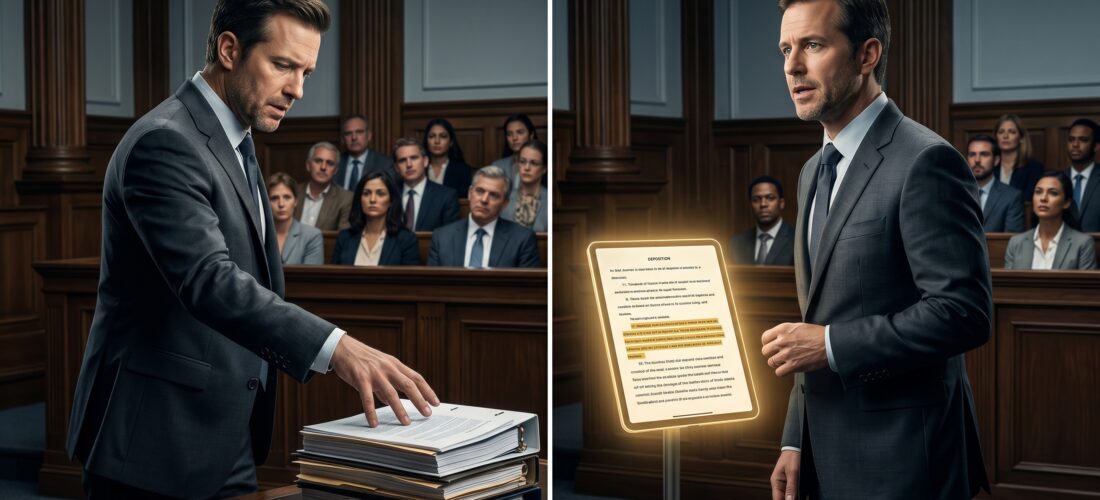
Discovery fatigue is the performance gap created when the volume and fragmentation of case materials exceeds an attorney’s practical ability to access them in real time. It is not a failure of preparation — it is a failure of tooling. The 50,000-document case file is the most visible version. The more common version is the 30-page deposition that needs cross-referencing against a medical record in a different binder, the exhibit number that surfaces correctly in the pre-trial prep but vanishes during cross-examination, or the email that changes the entire damages analysis if you can locate it before the witness steps down.
What makes this a 2026 compliance issue specifically: ABA Formal Opinion 512 requires attorneys to personally verify all AI-generated output before use. Florida’s Administrative Order 26-04 requires personal attorney certification on AI-assisted filings. When an attorney relies on a keyword search across a fragmented document stack to support that certification — and the search is imprecise, slow, or incomplete — the certification itself is potentially unsupportable. The fatigue is not just exhausting the attorney. It is undermining the documentation trail the compliance regime requires.
“Every second spent searching during cross-examination is a second opposing counsel uses to recover. But in 2026, it is also a second the documented activity trail is not being built.”
How Does the Neural Librarian Address Discovery Fatigue Differently From Keyword Search?
Traditional keyword search fails in litigation because legal documents do not work the way keywords do. A witness statement rarely uses the exact phrase you are looking for. A contradiction in a deposition is rarely labeled as such. A damages reference is often embedded in language that does not match the search term an attorney would type under courtroom pressure.
Lex Arca’s Neural Librarian uses semantic retrieval — understanding legal context, not just matching strings. When you ask ‘find the deposition where the plaintiff describes the incident timeline,’ the Neural Librarian does not return a list of documents containing those words. It returns the specific sentence, in the specific document, with the relevant passage already highlighted and ready for display. The response arrives within seconds. The attorney does not pause. The jury does not notice the hesitation that was not there.
Every retrieval event is logged in the append-only documented activity trail — building the verifiable record that ABA Opinion 512 compliance workflows require. The speed is the courtroom advantage. The log is the compliance infrastructure.
What Is the Role of Neural Sentinel in Managing Discovery Compliance Obligations?
Neural Sentinel is Lex Arca’s jurisdictional compliance gate, and it operates at the intersection of discovery and compliance in a specific way: before any AI-assisted analysis is delivered to the attorney — whether that is a deposition contradiction surfaced by the Neural Strategist or a document retrieved by the Neural Librarian — Sentinel checks the applicable standing court orders for that jurisdiction. It flags the specific disclosure and certification requirements. It generates a Verification Attestation certificate aligned with ABA Opinion 512.
For attorneys managing active matters in Florida, Texas, or any of the 300+ court order jurisdictions, this means every AI-assisted retrieval and analysis event has a compliance record attached to it before it is used. The documented activity trail is not reconstructed after the fact — it is built in real time, automatically, as the work is done. That is the architecture the compliance regime contemplates. That is what most platforms on the market do not provide.
What Should Paralegals and Legal Assistants Know About Discovery Fatigue and AI Compliance?
Paralegals and legal assistants managing document review in AI-integrated practices occupy a specific compliance position under ABA Opinion 512: the verification obligation rests with the licensed attorney, but the documented activity trail that satisfies that obligation begins at the research workstation. If a paralegal uses an AI tool to surface documents, draft deposition questions, or analyze a damages record — and there is no documented activity trail connecting that AI-assisted work to the final attorney review — the compliance gap is structural, not incidental.
Inside Lex Arca, the entire matter lives in one vault. Every document retrieval, every AI-generated analysis, every billing entry is logged in the same append-only documented activity trail and run through the same Neural Sentinel compliance gate. The paralegal’s AI-assisted research and the attorney’s verified output share the same compliance infrastructure. There is no gap between the workstation where the research happens and the certification the attorney signs.
“Discovery fatigue is optional. The compliance obligation to document the work that eliminates it is not. Lex Arca builds both into the same workflow.”
Key Takeaways
1. Discovery fatigue is a 2026 compliance issue as much as a performance issue — the inability to retrieve documents precisely and quickly undermines the personal verification obligation ABA Formal Opinion 512 imposes on AI-using attorneys.
2. Semantic retrieval, not keyword search, is the only retrieval architecture that performs under courtroom pressure — the Neural Librarian returns the specific passage, not a document list.
3. Neural Sentinel’s jurisdictional compliance gate builds a documented activity trail in real time as retrieval and analysis events occur — not as a retrospective reconstruction.
4. Lex Arca Legal Vault provides an integrated discovery and compliance workflow for solo and small-firm attorneys, with Neural Librarian retrieval, Neural Sentinel compliance gating, and an append-only tamper-evident documented activity trail.
5. Calculate your firm’s billing leakage and get early access at https://calculator.lex-arca.com.
→ Calculate Your Billing Leakage + Join the Founding Firms VIP Waitlist
About the Author
Kim Xi Harris is the Founder and CEO of Lex Arca Legal Vault, an AI-native litigation intelligence and compliance platform for solo and small-firm attorneys. She is a Cornell Women’s Entrepreneur Program graduate, SBA Women in Business Champion Award recipient, WOSB certified, and holds five Google AI certifications. Calculate your firm’s billing leakage and join the VIP waitlist at https://calculator.lex-arca.com — or reach us at legalvault@lex-arca.com.