By Kim Xi Harris | Founder & Platform Architect, Lex Arca™ Legal Vault | Calculate your firm’s billing leakage: https://calculator.lex-arca.com | legalvault@lex-arca.com
According to Clio’s 2026 Legal Trends Report for Solo and Small Law Firms (May 2026, https://www.clio.com/about/press/2026-solo-small-firm-report/), 71% of solo practitioners and 75% of small firms are now using AI to complete legal work — yet fewer than 33% have seen any revenue increase from it, compared to nearly 60% of enterprise firms. The gap between AI adoption and AI compliance is not a tool problem. It is an architecture problem.
Perplexity’s Computer for Counsel is a powerful research and workflow tool — and it does not generate a compliance record. It produces cited output. It does not produce the Verification Attestation, Expert Billing Attestation, or append-only tamper-evident audit trail that ABA Formal Opinion 512 requires of every attorney who uses AI in client matters. And for attorneys handling confidential client matters, the platform’s native architecture — running through Microsoft 365, SharePoint, Outlook, and Teams — introduces a Rule 1.6 confidentiality exposure the product announcement did not address.
What Is Perplexity’s Computer for Counsel, and Who Is It For?
Perplexity launched Computer for Counsel on June 24, 2026. The platform is an agentic AI system powered by more than 20 frontier AI models, built to connect legal research databases, document repositories, matter-management systems, and contract tools into a single workflow layer. Integrations include Midpage for case law, statutes, and citations; Clio for matter management; Docusign and NetDocuments for contract and document workflows; LegalZoom for templates; and Deel for compliance data.
The platform is explicitly aimed at small and mid-size firms and in-house teams. Above the Law’s analysis noted that global firms are not generally storing files in SharePoint and Box — but smaller teams do. For the attorney who cannot afford Harvey or Legora, Computer for Counsel is positioned as a capable, cited, workflow-connected alternative.
That positioning is legitimate as far as it goes. The question is what it does not address — and for litigation attorneys handling confidential client matters, two gaps are material.
What Confidentiality Risk Does a Cloud-Integrated Platform Create Under Rule 1.6?
Computer for Counsel is natively designed to operate inside Microsoft 365 — drafting documents in Word, retrieving files from SharePoint, and pulling context from Outlook and Teams. These are the exact systems where client communications, privileged work product, litigation strategy, and matter files live for most small-firm practitioners.
Model Rule 1.6 requires attorneys to make reasonable efforts to prevent the unauthorized disclosure of information relating to the representation of a client. When an AI platform is granted access to SharePoint file repositories, Outlook inboxes, and Teams channels to perform legal work, the attorney has introduced a third-party system into the confidential data environment of every client matter stored in those tools — not just the matter the AI was asked to help with.
An AI agent with access to your SharePoint is an AI agent with access to every client file in your SharePoint. Rule 1.6 does not distinguish between the folder you opened and the folders you didn’t.
Perplexity states that its Enterprise offering does not train on company data. That is a privacy protection — and it is not the same thing as a Rule 1.6 compliance structure. The question is not whether Perplexity retains the data. The question is whether the attorney has made reasonable efforts to prevent unauthorized disclosure by routing client-confidential information through a commercial cloud system that was not purpose-built for attorney-client privilege protection.
Ethical wall obligations compound this exposure. When a firm uses a platform with access to its full Microsoft 365 environment, the firm must confirm that the platform’s data access controls are sophisticated enough to honor the screening walls it has constructed between conflicted matters. A general-purpose AI agent operating across a shared cloud environment is not an ethical wall. It is a potential breach of one.
ABA Formal Opinion 512 explicitly addresses the attorney’s duty to understand the AI tools they use — including what data those tools can access, how that access is structured, and what the attorney’s supervisory obligations are over AI-generated output. A platform that accesses client files across a shared cloud environment requires the attorney to make a documented, affirmative determination that the deployment is consistent with Rule 1.6 obligations for every matter in that environment — not just the matter being actively researched.
What Compliance Problem Does Computer for Counsel Actually Solve — And What Does It Leave Open?
Computer for Counsel solves for research speed, citation accuracy, and workflow automation. These are valuable. They are not the full compliance picture.
ABA Formal Opinion 512 requires attorneys to maintain a documented, verifiable record of AI use — including what the system generated, what was reviewed, and what was filed. That obligation falls on the licensed attorney, not the AI vendor. Cited output is not a Verification Attestation. A research memo assembled by an AI agent is not an append-only tamper-evident audit trail.
More than 300 standing court orders now govern AI use in U.S. courtrooms. Florida’s Administrative Order SC2026-0673 (effective June 15, 2026) requires personal attorney certification on AI-assisted filings. Colorado’s SB 26-189 (signed May 14, 2026, effective January 1, 2027) mandates AI governance documentation statewide. The attorney who installs Computer for Counsel on Monday is still personally exposed by Thursday unless a compliance layer running beneath the research layer is generating the documentation those orders require.
What Does a Purpose-Built Litigation Compliance Platform Produce That a Research Platform Doesn’t?
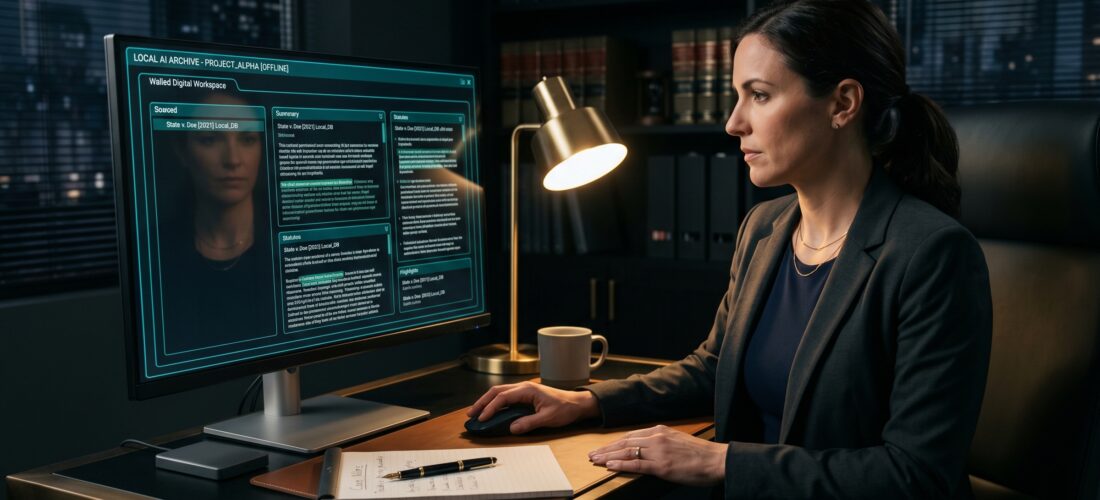
The differentiation is in the architecture, not the interface. A research platform grants AI agents access to your existing cloud environment to generate output. A litigation compliance platform is architecturally excluded from that environment by design — operating as a local-first private vault that does not route client-confidential matter data through commercial cloud infrastructure.
Lex Arca™ Legal Vault is architecturally excluded from your data — not by policy, not by contract, but by design. It does not require access to your SharePoint, your Outlook, or your Teams environment to function. Client-confidential matter information stays in a local-first private vault. The compliance record — a Verification Attestation, an Expert Billing Attestation, and an append-only tamper-evident audit trail — is generated from within that structure, not assembled by an agent operating across shared cloud storage.
That architectural distinction is not a marketing claim. It is a Rule 1.6 answer. For attorneys serving clients with confidentiality expectations that cannot be satisfied by a commercial cloud platform’s privacy policy, the choice of AI infrastructure is itself a professional responsibility decision. For a deeper read, see our analysis of why AI compliance in your litigation practice is not a checklist problem.
For firms evaluating Computer for Counsel: use it for what it does well. Confirm before deployment whether your Microsoft 365 environment’s data access controls are sufficient to satisfy Rule 1.6 obligations across every client matter stored there. And build the compliance record — Verification Attestation, documented activity trail, billing attestation — that Perplexity does not generate. See the full ABA Opinion 512 compliance workflow for what that record requires.
From Kim’s Chair: The Questions I Would Have Asked
I did not build Lex Arca™ from studying platform announcements. I built it from a chair — the client’s chair — where I watched what happens when the technology behind a legal matter is capable, connected, and operating across every file the attorney has ever touched on behalf of every client they have ever represented. When I read an announcement that describes an AI agent working directly from SharePoint and Outlook, I do not see a workflow tool. I see a key that opens every cabinet in the building — not just the one the attorney unlocked.
If I were in that courtroom as the client, here is what I would ask the room:
1. If the AI platform my attorney used to research my case had access to every other client’s files in the same cloud environment, at what point does that become a conflict I had a right to know about?
2. When Rule 1.6 requires reasonable efforts to prevent unauthorized disclosure, who decided that ‘the vendor does not train on the data’ satisfies that standard — and where is the bar ethics opinion that says so?
3. If an ethical wall exists in this firm to protect against a conflict between my matter and another client’s, how does a general-purpose AI agent operating across a shared cloud environment honor that wall?
4. How many attorneys in this room have deployed an AI platform with access to their full Microsoft 365 environment without conducting a Rule 1.6 analysis of what that access means for every client matter stored there?
And if I were your client — sitting across from you before you walked into that courtroom — here is what I would have asked you:
1. Does the AI tool you are using on my case have access to files from my matter only — or does it have access to your entire document environment, including other clients’ matters?
2. Have you made a documented determination that deploying this platform in your Microsoft 365 environment is consistent with your Rule 1.6 obligations to me?
3. If I am one of several clients whose files are stored in the same SharePoint that your AI agent can access, what prevents my confidential information from appearing in context that was pulled for another client’s work?
4. Is there a record I could review that shows what the AI accessed, what it generated, and what you personally verified before using it in my matter?
These are not theoretical questions. They are the questions a Rule 1.6 audit asks — and the silence where a purpose-built compliance architecture does not exist.
Key Takeaways
1. Perplexity’s Computer for Counsel, launched June 24, 2026, is a legitimate research and workflow tool for small and mid-size firms — and its native architecture, which operates through Microsoft 365, SharePoint, Outlook, and Teams, introduces a Model Rule 1.6 confidentiality exposure that attorneys must evaluate before deployment across client-matter environments.
2. Rule 1.6 requires attorneys to make reasonable efforts to prevent unauthorized disclosure of client information; granting an AI agent access to a shared cloud environment containing multiple client matters raises privilege, ethical wall, and disclosure obligations that a vendor’s data privacy policy does not resolve.
3. Computer for Counsel does not generate the Verification Attestation, Expert Billing Attestation, or append-only tamper-evident audit trail required under ABA Formal Opinion 512 — attorneys using the platform still carry the full compliance documentation obligation personally.
4. Lex Arca™ Legal Vault is architecturally excluded from your data — not by policy, not by contract, but by design — operating as a local-first private vault that does not require access to commercial cloud infrastructure to generate a documented, verifiable AI compliance record.
5. Calculate your firm’s billing leakage and explore the Founding Firms VIP program at https://calculator.lex-arca.com.
About the Author | Kim Xi Harris is the Founder and Platform Architect of Lex Arca™, an AI-native litigation intelligence and compliance platform for solo and small-firm attorneys. She is a Cornell Women’s Entrepreneur Program graduate, SBA Women in Business Champion Award recipient, WOSB certified, and holds five Google AI certifications. Calculate your firm’s billing leakage at https://calculator.lex-arca.com — or reach us at legalvault@lex-arca.com.
The vault is open.