By Kim Xi Harris Founder & Platform Architect, Lex Arca Legal Vault™ | Calculate your firm’s billing leakage | legalvault@lex-arca.com
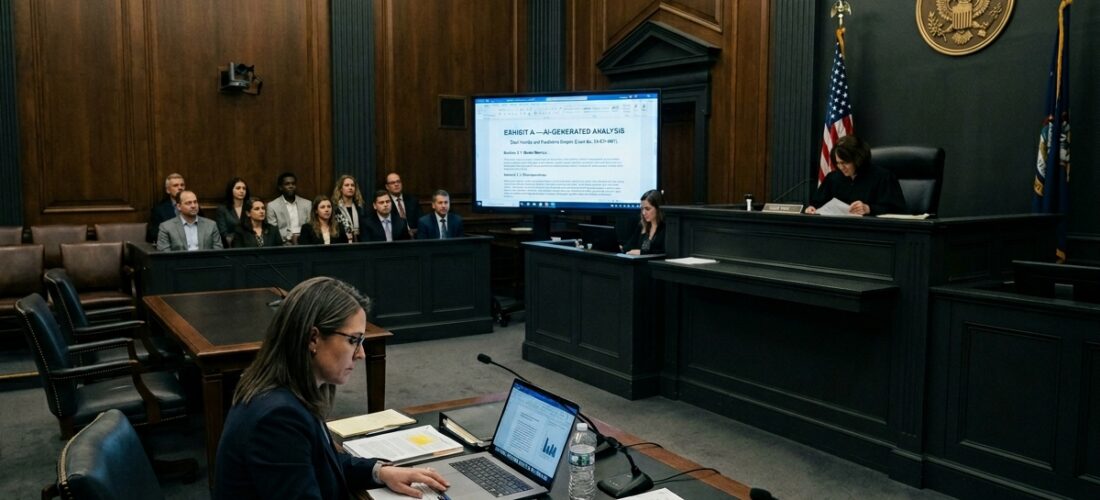
The Advisory Committee on Federal Rules of Evidence voted May 7, 2026 on Proposed Rule 707 — a new standard that would require AI-generated evidence to satisfy the same admissibility burden as expert testimony before it can be introduced in federal court. The committee report is due in June. If you use AI-generated outputs in your cases, this is the standard you are preparing for now — whether you know it exists or not.
What Does Proposed FRE 707 Actually Require?
Proposed Rule 707 treats machine-generated evidence as expert testimony for admissibility purposes. The proponent of AI-generated evidence must establish three elements before it is admitted: (1) the evidence is based on sufficient facts or data; (2) the AI system used is the product of reliable principles and methods; and (3) those principles and methods were reliably applied to the facts of the case. All three elements are on the proponent to prove — and any one of them can be the basis for exclusion.
The National Law Review has described Rule 707 as the most significant evidentiary development for AI in federal court since the Daubert standard emerged for expert witnesses. Meyers Nave’s analysis notes that courts are already applying Rule 702 expert-witness logic to AI-generated outputs in pre-FRE 707 rulings — meaning the evidentiary burden exists in practice even before the rule is formally adopted. Steptoe’s analysis of the SDNY’s application of proposed Rule 707 logic confirms that solo litigators in federal courts are already operating under the scrutiny the proposed rule would codify.
What Is the Deepfake Gap — and Why Does It Matter for Litigation Strategy?
Critics of Proposed Rule 707 have identified a significant coverage gap: the rule applies only to AI-generated evidence that is acknowledged as AI-generated by the proponent. It does not catch disputed-authenticity deepfakes — AI-generated videos, audio recordings, or images introduced as genuine evidence without disclosure. For litigators, this gap has two implications.
First, if you intend to introduce AI-generated evidence, Rule 707’s three-element burden applies — and you need the documentation infrastructure to satisfy it before trial. Second, if you believe opposing evidence may be AI-generated and disputed, the rule does not provide a clear exclusion pathway — requiring a different authentication challenge strategy under FRE 901 and 902. The gap between acknowledged and unacknowledged AI evidence is becoming a litigation strategy variable.
What Is the State-Level Patchwork Every Solo Litigator Must Track Right Now?
FRE 707 addresses federal court admissibility. At the state level, a parallel patchwork is already in effect. Louisiana’s Act 250 requires affirmative disclosure of AI-generated evidence at the time of introduction. California SB 11 mandates Judicial Council review of AI evidence standards, with a report due January 2027 — but courts in California are already applying informal authentication standards in advance of that review. Texas requires personal attorney certification that AI-generated content has been reviewed, accurate, and correctly attributed before introduction.
For solo practitioners who practice in multiple jurisdictions or handle federal matters with state-law claims, the compliance burden is multiplicative: Florida AO 26-04, Texas certification, Louisiana Act 250, California SB 11 standards, and federal FRE 707 logic may all apply to a single matter. Lex Arca’s Sentinel system tracks court-specific standing orders and jurisdiction-specific requirements across all active Sentinel jurisdictions — functioning as a compliance gate before AI synthesis runs.
What Does the Practitioner Workflow Look Like for AI-Generated Evidence Documentation?
Documenting the AI-generated evidence chain for FRE 707 purposes requires four components: (1) a record of the input — what data, prompts, and parameters produced the AI-generated output; (2) a record of the output — the specific AI-generated content as it existed at the time of generation; (3) a verification record — documenting that the attorney reviewed the output and confirmed the factual accuracy of any statements derived from it; and (4) a filing record — documenting that the evidence was introduced with the required disclosure certifications.
Lex Arca’s documented activity trail captures the first three components through Neural Strategist’s CPIE session logs, the Verification Attestation PDF, and the dual cryptographic audit system. The fourth component — filing record — integrates with the attorney’s existing filing workflow. Together, these components produce the documented evidence chain a Rule 707 admissibility challenge would require the proponent to produce. Building this record before trial — not in response to a Daubert-style challenge at the hearing — is the practitioner’s advantage.
Key Takeaways
1. Proposed FRE 707 (Advisory Committee vote: May 7, 2026; report due June 2026) would require AI-generated evidence to satisfy the same three-element admissibility burden as expert testimony — sufficient facts/data, reliable methods, reliable application.
2. The rule has a documented deepfake gap: it applies to acknowledged AI evidence, not to disputed-authenticity AI-generated content — creating a litigation strategy variable for both proponents and challengers.
3. A state-level patchwork — including Louisiana Act 250, California SB 11, Texas certification, and Florida AO 26-04 — already imposes AI evidence obligations in state courts, creating multiplicative compliance burdens for multi-jurisdiction practitioners.
4. Lex Arca Legal Vault™ provides a documented, verifiable AI activity trail designed to support attorney compliance workflows, including the input-to-output-to-verification documentation chain FRE 707 admissibility challenges require.
5. Calculate your firm’s billing leakage and get early access at https://calculator.lex-arca.com.
About the Author
Kim Xi Harris is the Founder and Platform Architect of Lex Arca™, an AI-native litigation intelligence and compliance platform for solo and small-firm attorneys. She is a Cornell Women’s Entrepreneur Program graduate, SBA Women in Business Champion Award recipient, WOSB certified, and holds five Google AI certifications. Calculate your firm’s billing leakage and join the VIP waitlist at https://calculator.lex-arca.com — or reach us at legalvault@lex-arca.com.