By Kim Xi Harris Founder & Platform Architect, Lex Arca™ Legal Vault | calculator.lex-arca.com | legalvault@lex-arca.com
According to Clio’s 2026 Legal Trends Report for Solo and Small Law Firms (May 2026), 71% of solo practitioners and 75% of small firms are now using AI to complete legal work — yet fewer than 33% have seen any revenue increase from it, compared to nearly 60% of enterprise firms. The gap between AI adoption and AI results is not a training problem. It is an architecture problem.
The 2026 legal technology research consensus has converged on a point that practitioners already know from experience: the AI tools that deliver value are not the ones that require attorneys to open a new window, navigate to a separate platform, and formulate a structured query. They are the ones embedded in the work itself.
Why Does the Distance Between a Tool and the Moment You Need It Matter?
The 2026 legal technology research consensus has converged on a point that practitioners already know from experience: the AI tools that deliver value are not the ones that require attorneys to open a new window, navigate to a separate platform, and formulate a structured query. They are the ones embedded in the work itself.
Rutvik Rau, Co-Founder of August, noted in Artificial Lawyer’s 2026 predictions roundup that legal AI will move “out of chat boxes and into the fabric of legal work — living inside email, documents, and matter systems.” The tools that change litigation outcomes are not ones you go to. They are ones that are already there when the moment arrives.
This matters in a courtroom because courtroom authority is transmitted through micro-signals — the beat between a witness’s answer and the follow-up question, the speed at which a document surfaces, the presence or absence of a pause when the attorney needs to change direction.
What Does Case-Specific Retrieval Produce That Keyword Search Cannot?
Case-specific retrieval produces answers drawn from the actual record — not from a database of all legal documents, not from a general search of case law, but from the specific depositions, exhibits, correspondence, and evidence that make up this matter. The distinction matters because courtroom effectiveness depends on the particular contradiction in this deposition, the specific passage in this medical record, the exact language in this contract.
Lex Arca™ Legal Vault’s Neural Librarian provides retrieval that is specific to the case vault it is working from. An attorney can ask a plain-language question about the record and receive the relevant passage, surfaced from the documents that have been ingested into that matter’s vault. The retrieval is case-specific because the environment it operates in is case-specific.
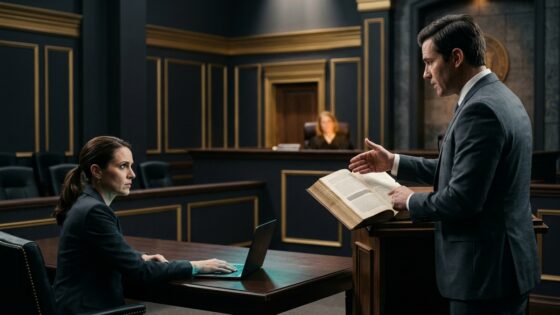
For cross-examination, this matters in a direct and immediate way. When a witness makes a statement that contradicts a deposition from two years ago, the value of surfacing that contradiction depends on timing. A contradiction produced in the room, without a pause, while the deponent is still processing the follow-up question — changes the dynamic of every answer that comes after.
What Is Semantic Highlighting and Why Does It Change Jury Communication?
Semantic highlighting is the capability that resolves the most consistent failure point in exhibit presentation: producing a document for a jury and expecting them to locate the relevant passage independently.
Jurors do not read documents the way attorneys do. They scan. They lose their place in multi-page exhibits. The argument that was supposed to land in a specific sentence gets absorbed into the surrounding text and does not register with the clarity the moment required.
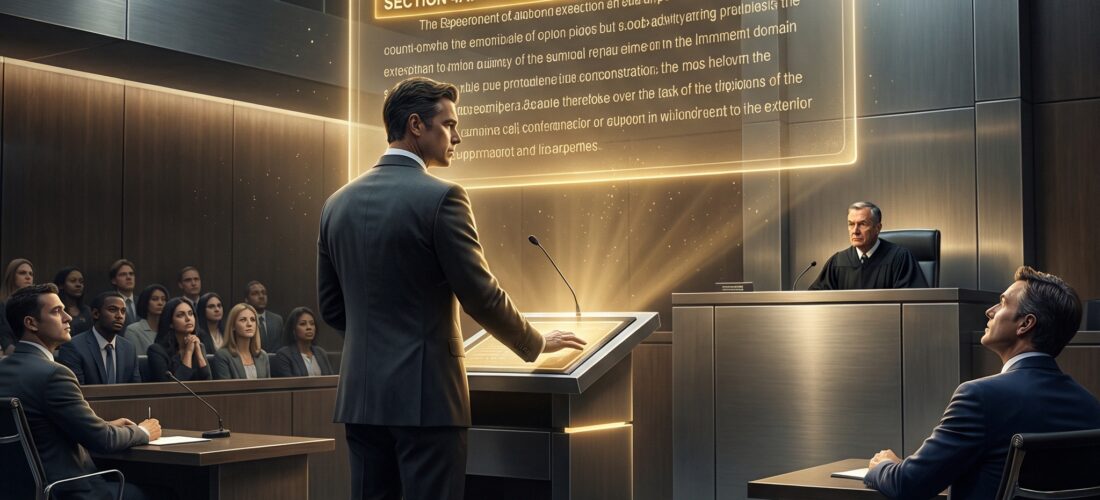
When the Neural Librarian surfaces a document inside Lex Arca™ Legal Vault, the relevant passage is highlighted — making the argument visible at the moment it needs to land, not buried in context the jury has to navigate on their own. This is not a display feature. It is a communication tool that removes the most common point of failure between what an attorney intends a jury to see and what the jury actually sees.
What Is the Compliance Foundation That Makes Courtroom Intelligence Defensible?
The courtroom presence and the compliance record are not separate questions. The attorney who prepared with documented, attorney-supervised AI synthesis — whose preparation record is captured in an append-only, tamper-evident audit trail — arrives in the courtroom with a different foundation than the attorney who used AI tools without that documentation layer.
As of 2026, more than 300 standing court orders govern AI use in filings and preparation. Florida’s Administrative Order SC2026-0673 / AOSC26-12 (effective June 15, 2026) requires personal attorney certification on AI-assisted work. ABA Formal Opinion 512 requires documented review of every AI output before it is incorporated into a preparation document or filing.
A litigation intelligence platform for solo firms that generates a Verification Attestation aligned to ABA Opinion 512 compliance workflows for every AI-assisted session is not just a compliance tool. It is the evidentiary foundation of a preparation posture that holds up when it is challenged.
From Kim’s Chair: The Questions I Would Have Asked
I sat in a courtroom as a client and watched what it looks like when an attorney has everything they need at their fingertips — and what it looks like when they don’t. I didn’t understand, at the time, what produced the difference. I thought it was experience. I thought it was confidence. I learned later that a significant part of it was infrastructure.
If I were in that courtroom as the client, here is what I would ask the room:
1. How many attorneys in this room have accepted a hesitation in cross-examination as a preparation shortcoming when it was actually a tooling shortcoming?
2. If a contradictory document surfaced after a witness left the stand because it couldn’t be retrieved in time, whose failure was that — and was it preventable?
3. Is workflow-native litigation intelligence equally available to the solo practitioner in the back of this room, or is it still a large-firm infrastructure advantage?
4. At what point does the gap between available retrieval tools and actual adoption become a question about preparation quality — not just efficiency?
5. How many clients in this room would be surprised to learn that the speed of their attorney’s document retrieval was partly determined by which software subscription they could afford?
And if I were your client — sitting across from you before you walked into that courtroom — here is what I would have asked you:
1. If a witness says something unexpected during cross-examination, how long will it take you to surface the document that contradicts it?
2. Is the retrieval tool you’re using working from my specific case record — or from a general legal database that does not know my case?
3. Is there a compliance record for the AI preparation you are doing on my matter — something you could produce if the basis for a question were challenged?
4. Have you personally reviewed every AI-generated output that is shaping your preparation, and is there a documented trail of that review?
5. Does the presence of your litigation intelligence platform in that room give you a preparation depth that matches what the other side is bringing — or is there still a gap?
These are not hostile questions. They are the questions that documentation answers — and the silence where documentation does not exist.
Key Takeaways
1. Workflow-native litigation intelligence changes courtroom outcomes because it operates inside the moment the attorney is already in — active during cross-examination and deposition, not consulted between sessions — which eliminates the hesitation that opposing counsel and jurors read as a signal about preparation.
2. Case-specific retrieval from the Neural Librarian produces answers drawn from the actual matter record, not from a general legal database — which means contradictions surface from the specific depositions and exhibits in the case, not from analogous documents in other matters.
3. ABA Formal Opinion 512 requires documented attorney review of every AI output before it shapes a filing or preparation document — and the compliance record that satisfies that requirement also provides the evidentiary foundation for preparation decisions that may be challenged in the room.
4. Lex Arca™ Legal Vault provides a documented, verifiable AI activity trail — including the Neural Librarian for case-specific retrieval, semantic highlighting for exhibit presentation, and a Verification Attestation for the preparation record — designed to support attorney compliance workflows while closing the trial technology gap for independent litigators.
5. Calculate your firm’s billing leakage and explore the platform at calculator.lex-arca.com.
About the Author Kim Xi Harris is the Founder and Platform Architect of Lex Arca™ Legal Vault, an AI-native litigation intelligence and compliance platform for solo and small-firm attorneys. She is a Cornell Women’s Entrepreneur Program graduate, SBA Women in Business Champion Award recipient, WOSB certified, and holds five Google AI certifications. Calculate your firm’s billing leakage at calculator.lex-arca.com — or reach us at legalvault@lex-arca.com.
The vault is open.