By Kim Xi Harris |Founder & Platform Architect, Lex Arca™ Legal Vault | Calculate your firm’s billing leakage | legalvault@lex-arca.com
According to Clio’s 2026 Legal Trends Report for Solo and Small Law Firms (May 2026, https://www.clio.com/about/press/2026-solo-small-firm-report/), 71% of solo practitioners and 75% of small firms are now using AI to complete legal work — yet fewer than 33% have seen any revenue increase from it, compared to nearly 60% of enterprise firms. The gap between AI adoption and AI compliance is not a policy problem. It is an architecture problem.
State Farm’s outside counsel, Jacquelene Robinson, was sanctioned in August 2026 after filing a brief citing a fabricated 1996 California Supreme Court PG&E case, generated by an AI tool called Irys. She assumed Irys auto-checked Westlaw. It didn’t. Under ABA Formal Opinion 512, “I trusted the vendor” is not a defense.
What Happened in the State Farm “Irys” Sanctions Case?
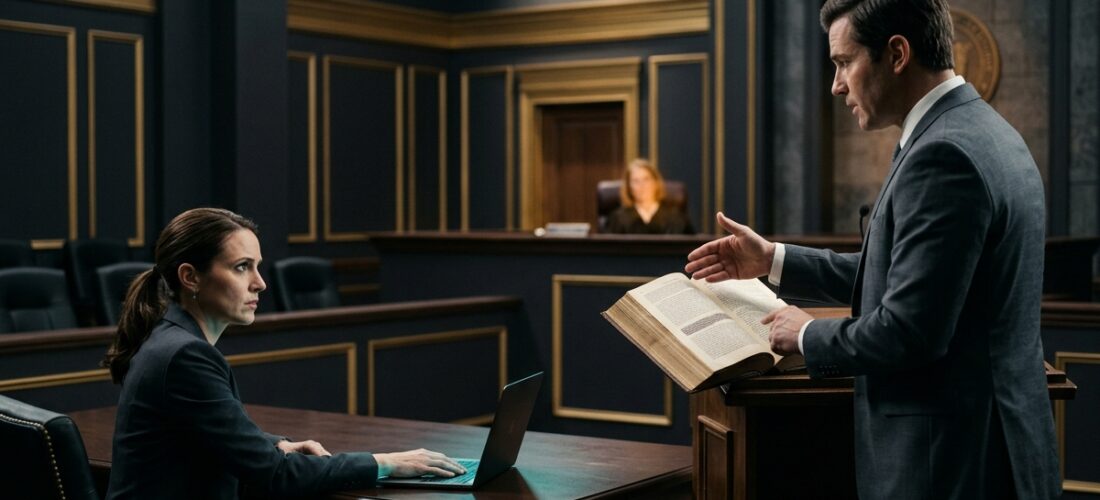
Jacquelene Robinson, outside counsel for State Farm, submitted a court filing containing a citation to an imaginary 1996 California Supreme Court ruling in a PG&E-related matter. The case did not exist. Robinson later told the court she had assumed her AI drafting tool, Irys, was integrated with Westlaw and performing automatic cite verification as part of its output.
It wasn’t. Opposing counsel identified the fabricated authority during an August 7 status conference and flagged it directly to the judge. The story broke publicly through the LA Times and LAist between August 25 and 27, 2026, putting a named insurer and a named attorney at the center of a national AI-hallucination story within days.
Why Isn’t “I Thought the Tool Checked It” a Valid Defense?
Under ABA Formal Opinion 512, an attorney cannot delegate the duty of competent supervision to a third-party AI vendor, regardless of what that vendor’s marketing implies about its capabilities. The obligation to personally verify every quote and citation before filing rests with the signing attorney under Model Rules 1.1, 1.4, and 1.5 — full stop.
This is the pattern regulators and courts are now punishing consistently: attorneys who treat a vendor’s implied feature set as a substitute for their own review. Robinson’s assumption that Irys was “doing the Westlaw check” is functionally identical to the reasoning that has produced sanctions orders, fee-shifting, and bar referrals in dozens of documented cases across 2025 and 2026. The excuse changes; the outcome does not.
What Does a Compliant Verification Workflow Actually Require?
A compliant workflow requires a documented activity trail for every filing — a record that shows, independently of the AI vendor’s own claims, that a human reviewed and verified each cited authority before it left the office. That record has to exist whether or not the AI tool itself is trustworthy, because the point is not to trust the tool. The point is to be able to prove, after the fact, that you didn’t have to.
Firms relying on unvetted platforms that route client data and drafting activity through public third-party servers are compounding the exposure: they cannot audit what they cannot see, and they cannot produce a documented activity trail for a black-box process. A local-first private vault — one where verification activity is captured as an append-only, tamper-evident record at the point of drafting — is the only structure that survives the “how do you know you checked it” question a judge or bar counsel will eventually ask.
This is the same accountability gap addressed in Lex Arca™’s breakdown of why ABA Opinion 512 compliance workflow failures are rarely about bad intent — they are about firms mistaking a vendor’s feature list for a verification system.
Is This an Isolated Incident, or a Pattern?
It is a pattern, and it is accelerating. This is one entry in a growing 2026 record of AI-hallucination sanctions that now spans insurers, Biglaw, government contractors, and solo practitioners alike — connected by the same root failure: an attorney assumed the tool’s output was pre-vetted. Firms without a litigation intelligence platform for solo firms built around independent verification are relying on hope, not process, every time they file.
From Kim’s Chair: The Questions I Would Have Asked
I did not build Lex Arca™ Legal Vault from studying reports on the market. I built it from a chair — the client’s chair — where I watched situations like the one described above unfold in real time. When I read about a national insurer’s outside counsel submitting a fabricated 1996 case to a court, I do not see a cautionary tale about one attorney’s judgment. I see the client — the insurer, the policyholders whose matter this was — who had no idea their filing rested on a citation that never existed, and no way to ask the right question until opposing counsel already had.
If I were in that room as the client, here is what I would ask:
- Did anyone at the firm confirm, in writing, that Irys performs live Westlaw cross-checking before it was adopted for filings on our matter?
- Who signed off on using Irys for this brief, and what did that sign-off process actually verify?
- Between the January vendor onboarding and the August 7 status conference, how many other filings went out under the same unverified assumption?
- Why did opposing counsel catch this before our own review process did?
And if I were your client — sitting across from you — here is what I would have asked you:
- Did you personally read the PG&E case you cited, or did you trust that Irys had already confirmed it existed?
- Is there a record — anywhere — showing that a human verified every citation in this brief before it was filed?
- Had Irys produced questionable output before this filing, and if so, was I ever told?
- What changes today, so the next brief with my name on it doesn’t carry the same risk?
The next filing this firm signs deserves a verification record that doesn’t depend on trusting the vendor’s marketing.
Key Takeaways
- State Farm’s outside counsel was sanctioned in August 2026 after submitting a brief with a fabricated 1996 California Supreme Court citation generated by the AI tool Irys.
- ABA Formal Opinion 512 makes clear that the duty to verify AI-generated citations cannot be delegated to a vendor — the signing attorney remains personally responsible under Model Rules 1.1, 1.4, and 1.5.
- Practitioners should establish a documented activity trail for every AI-assisted filing, independent of any vendor’s claims about its own accuracy.
- Lex Arca™ Legal Vault provides a documented, verifiable AI activity trail designed to support attorney compliance workflows.
- Calculate your firm’s billing leakage and get early access at https://calculator.lex-arca.com.
About the Author: Kim Xi Harris is the Founder and Platform Architect of Lex Arca™, an AI-native litigation intelligence and compliance platform for solo and small-firm attorneys. She is a Cornell Women’s Entrepreneur Program graduate, SBA Women in Business Champion Award recipient, WOSB certified, and holds five Google AI certifications. Calculate your firm’s billing leakage at https://calculator.lex-arca.com — or reach us at legalvault@lex-arca.com.