By Kim Xi Harris
Founder & CEO, Lex Arca Legal Vault | Check your firm’s billing leakage https://calculator.lex-arca.com
Market Context
According to Clio’s 2026 Legal Trends Report for Solo and Small Law Firms (May 2026, https://www.clio.com/about/press/2026-solo-small-firm-report/), 71% of solo practitioners and 75% of small firms are now using AI to complete legal work — yet fewer than 33% have seen any revenue increase from it, compared to nearly 60% of enterprise firms. The gap between AI adoption and AI compliance is not a policy problem. It is an architecture problem.
Justice Amy Coney Barrett said it plainly during a public appearance in Bentonville, Arkansas this week:
“The court is not using AI because it would be insecure. So you can trust that our opinions are not AI-generated.”
Read that again.
The Supreme Court of the United States — the institution that interprets the laws governing every courtroom where you practice — has declined to use AI because it cannot adequately guarantee the security and verifiability of its output. The highest legal authority in the country is telling you, without ambiguity, that unverified AI is not trustworthy enough for their work.
And yet 75% of U.S. attorneys are using AI tools right now. Today. In active litigation matters. Most with no documented activity trail, no Sentinel jurisdictional gate, and no compliance proof chain to show a judge if something goes wrong.
That gap is not theoretical. It is a $145,000+ sanctions problem — in the first quarter of 2026 alone.
What exactly did SCOTUS say about AI — and why does it matter to litigators?
Justice Barrett’s comment was not a sweeping policy statement. It was something more telling: a candid acknowledgment that the Court’s own internal standards require output they can stand behind with certainty. AI, in its current general-purpose deployment, does not clear that bar for them. Security risk. Verification risk. Attribution risk.
These are not abstract concerns. They are the same risks that got a DOJ attorney terminated in March 2026 for submitting fabricated citations in a federal brief — and that resulted in an Oregon attorney facing $109,700 in sanctions in a single case. More than 300 federal judges now have standing orders specifically addressing AI use in court filings. The judiciary is watching. SCOTUS just made their position on unverified AI output explicit.
If the court writing the opinions won’t use unverified AI, the attorneys appearing before courts should not be submitting AI-assisted filings without a documented, verifiable compliance trail.
What does “insecure AI” actually mean in a litigation context?
When Justice Barrett uses the word “insecure,” she is describing something every litigator needs to understand in practical terms. General-purpose AI tools — tools not built for litigation compliance — present three categories of professional risk:
Hallucination risk. A researcher at HEC Paris has tracked nearly 1,400 documented cases globally where AI generated fabricated citations that were submitted to courts. Five to six new cases are added to that database every single day. The courts catching these errors are not lenient. Sanctions range from mandatory continuing education to career-ending bar referrals.
Data security risk. Most AI legal tools route your client matter data through third-party cloud infrastructure the vendor controls. Your client communications, case strategy, discovery materials — processed on servers outside your architecture. That is not a theoretical confidentiality issue. That is an ABA Formal Opinion 512 compliance issue.
Verification risk. Forty-four percent of law firms currently have no formal AI governance policy. No disclosure protocol. No documented review workflow. When a judge asks how you verified the AI-assisted content in your filing, “I used a reputable tool” is not an answer that protects your license.
What does a compliant AI litigation workflow actually require?
ABA Formal Opinion 512 makes the standard clear: attorneys must maintain a reasonable understanding of every AI tool used in their practice, personally verify all AI-generated output before filing, and disclose AI use to clients when it is material to the representation. That obligation is enforceable under Model Rules 1.1, 1.4, and 1.5 — and it cannot be delegated to a vendor, a paralegal, or a software provider.
What that means in practice is not just a policy. It is a documented activity trail.
Florida Administrative Order 26-04, issued in January 2026, now requires personal attorney certification on AI-assisted filings. Texas requires attorneys to personally certify they reviewed every AI-assisted statement. More jurisdictions are following. The standard is moving from “did you use AI responsibly” to “can you prove it.”
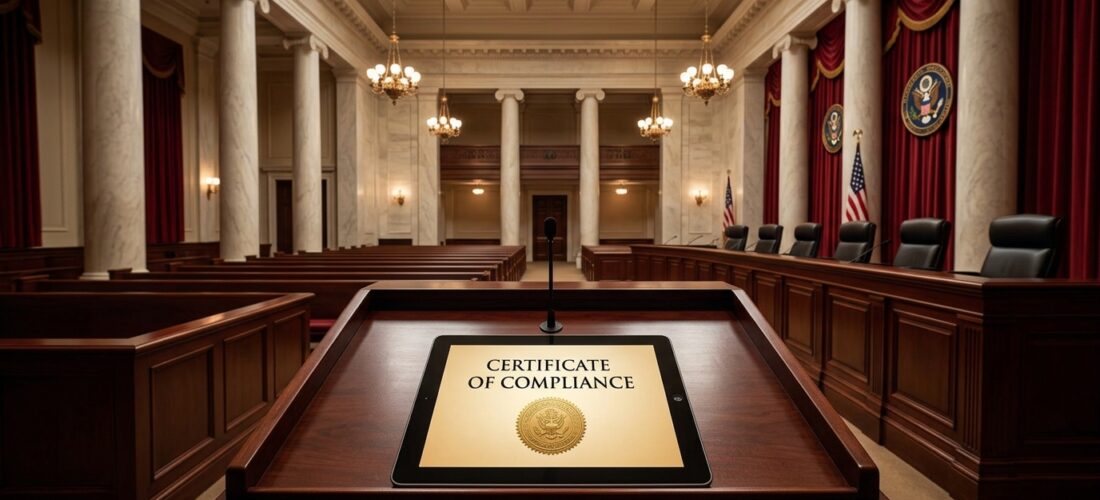
The distinction is architectural. A policy lives in a PDF in your firm handbook. A proof chain lives in your litigation workflow — a Sentinel jurisdictional gate that blocks no-go jurisdictions before synthesis begins, an AI Compliance Certification generated at the moment of use, and an append-only, tamper-evident activity log that documents every step. Documented and verifiable — not just asserted.
What is the practical difference between AI tools that create risk and AI tools that reduce it?
The legal AI market in 2026 divides cleanly into two categories. The first category gives you AI output. The second category gives you AI output plus a documented, verifiable compliance proof chain.
The first category is what Justice Barrett was describing when she said “insecure.” Capable. Fast. Useful. But not defensible when a judge asks the hard question.
The second category is what Lex Arca Legal Vault was built to be. The Neural Strategist synthesizes your case with your vault — your documents, your facts, your jurisdiction — filtered through Sentinel before a single inference runs. The Verification Attestation certificate captures that synthesis with a cryptographically timestamped audit trail. The Expert Billing Attestation PDF provides a documented activity trail for every billable AI-assisted event. Four steps. Every time. Not a policy. A proof chain.
Legora serves Linklaters. Harvey serves Sullivan & Cromwell — the same firm that apologized to a federal judge last month for AI-fabricated citations. Lex Arca was built for the 400,000 solo and small-firm litigators that enterprise legal AI explicitly excludes, practicing in the same courts where Justice Barrett’s colleagues are writing those standing orders.
Key Takeaways
1. Justice Amy Coney Barrett publicly stated in May 2026 that the Supreme Court does not use AI in writing opinions because the technology presents security and verification risks their standards cannot accept — a signal that judicial scrutiny of AI-assisted legal work will only intensify.
2. U.S. courts imposed more than $145,000 in AI hallucination sanctions in Q1 2026 alone, with one Oregon attorney facing $109,700 in a single case — and more than 300 federal judges have adopted standing orders on AI use in filings as of this year.
3. Solo and small-firm attorneys must treat AI compliance not as a policy question but as an architecture question: documented, verifiable proof chains — not handbook language — are what courts are beginning to require.
4. Lex Arca Legal Vault provides a documented, verifiable AI activity trail designed to support attorney compliance workflows, including a Sentinel jurisdictional gate, AI Compliance Certification, and an append-only, tamper-evident billing and activity ledger aligned with ABA Formal Opinion 512.
5. Calculate your firm’s billing leakage and get early access at https://calculator.lex-arca.com.
About the Author: Kim Xi Harris is the Founder and CEO of Lex Arca Legal Vault, an AI-native litigation intelligence and compliance platform for solo and small-firm attorneys. She is a Cornell Women’s Entrepreneur Program graduate, SBA Women in Business Champion Award recipient, WOSB certified, and holds five Google AI certifications. Calculate your firm’s billing leakage and join the VIP waitlist at https://calculator.lex-arca.com — or reach us at legalvault@lex-arca.com