By Kim Xi Harris | Founder & Platform Architect, Lex Arca™ Legal Vault | Calculate your firm’s billing leakage | legalvault@lex-arca.com
According to Clio’s 2026 Legal Trends Report for Solo and Small Law Firms (May 2026, https://www.clio.com/about/press/2026-solo-small-firm-report/), 71% of solo practitioners and 75% of small firms are now using AI to complete legal work — yet fewer than 33% have seen any revenue increase from it, compared to nearly 60% of enterprise firms. The gap between AI adoption and AI compliance is not a policy problem. It is an architecture problem.
On March 30, 2026, the Seventh Circuit admonished an attorney in Dec v. Mullin for filing a brief with two non-existent case citations and a fabricated quotation — then went further, noting that opposing counsel’s failure to catch the fabrications “gives us pause, albeit to a lesser degree.” The message for every litigator: verifying only your own citations is no longer the full job.
What Did the Seventh Circuit Actually Rule in Dec v. Mullin?
Dec v. Mullin, No. 25-2417 (7th Cir. Mar. 30, 2026), arose from Danuta Dec’s petition challenging a USCIS denial of her unlawful-presence waiver under 8 U.S.C. § 1182(a)(9)(B)(v). The Seventh Circuit, in an opinion authored by Judge Michael B. Brennan, held it lacked jurisdiction to review the discretionary waiver decision and dismissed the appeal on that threshold ground. Separately, the panel addressed a practice-facing problem: Dec’s opening brief cited two cases that do not exist and recounted a quotation that was never said, bearing what the court called the tell-tale signs of an AI hallucination.
Counsel initially denied using AI when questioned at oral argument. She later filed a letter admitting the citations had been copied from another, unlocatable brief and apologized for failing to verify them. Because the fabricated authority appeared only in a standard-of-review section that did not affect the jurisdictional outcome, and because counsel accepted responsibility, the panel chose admonishment in a published opinion rather than a monetary sanction or referral for discipline.
Why Did the Court Say Opposing Counsel’s Failure to Catch the Errors “Gives Us Pause”?
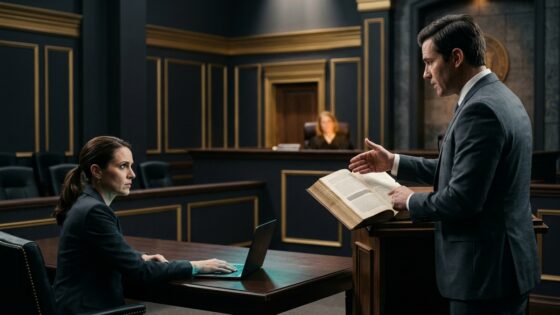
The Seventh Circuit did not stop at the lawyer who filed the defective brief. Counsel for the Secretary of Homeland Security also read Dec’s brief, also had access to the same primary-source databases, and also failed to flag the fabricated citations before the panel had to raise the issue itself. The court’s phrase — “gives us pause, albeit to a lesser degree” — signals that the duty to catch hallucinated authority is no longer understood as belonging only to the side that filed it.
This is not an isolated data point. In Noland v. Land of the Free, L.P., a California Court of Appeal imposed a $10,000 sanction and a State Bar referral against the attorney who filed AI-fabricated citations — but separately declined to award attorney’s fees to opposing counsel, because that side had also failed to alert the court to the same fabricated authority. In Landberg v. City of New York, a panel questioned opposing counsel directly at oral argument for not raising hallucinated citations it had every opportunity to catch. Across circuits, the pattern is consistent: courts increasingly expect both sides of a case to help police AI-generated fabrications, not just the side that produced them.
How Do Federal Circuits Differ in Punishing AI Hallucinations?
The Seventh Circuit’s admonishment-only outcome in Dec looks lenient next to the Sixth Circuit’s response in United States v. Farris, decided four days later on April 3, 2026. There, the Sixth Circuit called the underlying conduct inexcusable regardless of intent, and imposed forfeiture of fees, removal of counsel from the case, and a referral to the Chief Judge of the Sixth Circuit for potential discipline. Both courts agree that AI does not dilute an attorney’s duty to verify; they diverge sharply on consequence once that duty is breached, weighing factors like whether the errors affected the merits, whether counsel accepted responsibility, and whether the conduct appeared strategic or merely careless.
For solo and small-firm litigators, that divergence is the real risk. More than 300 standing court orders on AI-generated filings are now in effect nationally, and a firm cannot assume its circuit will treat a hallucinated citation the way the Seventh Circuit treated Dec’s. The safer assumption, wherever you practice, is the Sixth Circuit’s standard — because that is the one that ends a case.
Firms building a defensible verification practice ahead of their next appellate filing can review the ABA Opinion 512 compliance workflow Lex Arca™ has published for solo and small-firm attorneys navigating exactly this exposure.
What Should Attorneys Do Before Filing — or Responding to — an AI-Drafted Brief?
Shared vigilance means the verification workload just doubled. It is no longer enough to check your own citations before you file; Dec signals that courts now expect you to check your opponent’s citations too, the moment their brief lands on your desk. For a solo practitioner or a two-partner litigation shop already stretched across trial prep, discovery, and billing, manually cite-checking two briefs instead of one is not a sustainable workflow — it is a second full-time job layered onto the first.
This is precisely the gap Lex Arca™ Legal Vault was built to close. As a litigation intelligence platform for solo firms, it gives attorneys retrieval within seconds in plain English against primary-source law — so an incoming brief from opposing counsel can be verified before your response is due, not after a judge asks why you didn’t catch it. Every check produces a documented activity trail, giving your firm a defensible record of diligence on both sides of the caption. If shared vigilance is now the standard the courts are enforcing, the firms that get ahead of it — rather than absorb the extra hours by hand — are the ones positioned to win the next Founding Firms advantage before their competitors even notice the rule has changed.
From Kim’s Chair: The Questions I Would Have Asked
I did not build Lex Arca™ Legal Vault from studying reports about the market. I built it from a chair — the client’s chair — where I watched a case turn on paperwork I never got to see before it was filed. When I read about Dec v. Mullin, I do not see an attorney’s embarrassing footnote. I see Danuta Dec, a woman who lost her waiver challenge, remains subject to a ten-year re-entry bar, and had no way of knowing that the brief filed in her name — and the government’s response to it — both went unchecked.
If I were in that immigration appeal as the client, here is what I would ask:
1. If two fabricated case citations sat in my brief long enough to reach a federal panel, why did neither my attorney nor the government’s attorney catch them first?
2. When my attorney was asked directly at oral argument whether AI was used, why was a denial that later needed a correcting letter treated as an acceptable first answer?
3. If the Seventh Circuit can say opposing counsel’s failure to flag fabricated citations “gives us pause,” why does that pause not carry any consequence for the government’s side of my case?
4. Since my waiver was already going to be dismissed on jurisdictional grounds, did the fabricated authority in my own brief change anything for me — or only for my attorney’s record?
And if I were your client — sitting across from you — here is what I would have asked you:
1. Before you filed my brief, did you personally confirm that both cited cases exist and that the quotation you used was actually said?
2. When the court asked you about AI use, why didn’t you tell them the truth in that moment instead of in a follow-up letter?
3. Now that your name carries a published admonishment in a federal circuit opinion, does that follow me the next time I need you to represent me?
4. If you expect the other side’s filings to be accurate, are you checking them as carefully as you’d want your own checked?
The next brief that lands on your desk — yours or your opponent’s — deserves the same scrutiny the Seventh Circuit applied after the fact, not before your reply is due.
Key Takeaways
1. On March 30, 2026, the Seventh Circuit admonished an attorney in Dec v. Mullin for filing a brief with two fabricated case citations and a false quotation, while separately noting that opposing counsel’s failure to catch the errors “gives us pause.”
2. Dec signals a shift toward shared vigilance: courts increasingly expect both sides of a case, not just the filer, to catch AI-generated fabrications before they reach the bench.
3. Circuits are not consistent — the Sixth Circuit’s harsher response in United States v. Farris shows that assuming leniency is a dangerous bet regardless of where a firm practices.
4. Lex Arca™ Legal Vault provides a documented, verifiable AI activity trail designed to support attorney compliance workflows on both sides of a filing.
5. Calculate your firm’s billing leakage and get early access at https://calculator.lex-arca.com.
About the Author | Kim Xi Harris is the Founder and Platform Architect of Lex Arca™, an AI-native litigation intelligence and compliance platform for solo and small-firm attorneys. She is a Cornell Women’s Entrepreneur Program graduate, SBA Women in Business Champion Award recipient, WOSB certified, and holds five Google AI certifications. Calculate your firm’s billing leakage at https://calculator.lex-arca.com — or reach us at legalvault@lex-arca.com.