By Kim Xi Harris |Founder & Platform Architect, Lex Arca™ Legal Vault | Calculate your firm’s billing leakage | legalvault@lex-arca.com
According to Clio’s 2026 Legal Trends Report for Solo and Small Law Firms (May 2026, https://www.clio.com/about/press/2026-solo-small-firm-report/), 71% of solo practitioners and 75% of small firms are now using AI to complete legal work — yet fewer than 33% have seen any revenue increase from it, compared to nearly 60% of enterprise firms. The gap between AI adoption and AI compliance is not a policy problem. It is an architecture problem.
Florida’s amended Rule 2.515(d)(2), effective June 15, 2026, requires every attorney signing a court filing to personally certify that all cited legal authority actually exists. Violating that certification can mean stricken filings, opposing counsel’s fees, or a disciplinary referral — replacing Florida’s patchwork of circuit-by-circuit AI orders with one statewide mandate.
What Does Florida’s Amended Rule 2.515(d)(2) Actually Require?
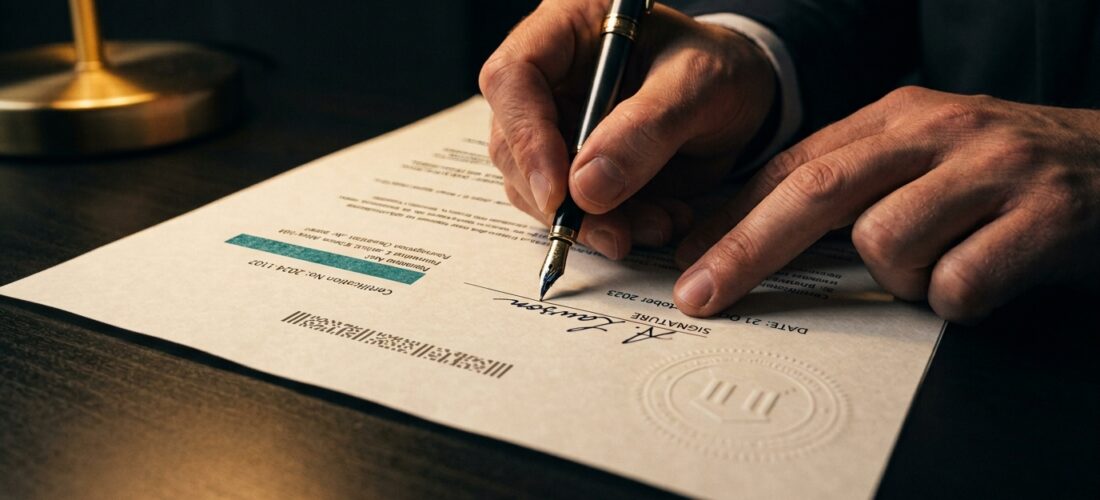
Effective June 15, 2026, Rule 2.515(d)(2) requires the signing attorney to personally certify that every piece of cited legal authority in a filing is valid and exists — not that a vendor or an AI tool confirmed it, but that the attorney did. The certification attaches to the signature itself, which means it cannot be satisfied by a general firm policy or a delegated review; it has to be true of the individual attorney whose name is on the document.
This closes the exact gap that produced sanctions in cases like State Farm’s Irys filing earlier this year, where an attorney assumed a vendor tool was doing the verification the rule now requires her to do personally.
What Happens If an Attorney’s Certification Turns Out to Be Wrong?
Non-compliance carries direct consequences: the court can strike the document, the attorney can be ordered to pay the opposing side’s fees, and the State Bar can pursue a direct disciplinary reprimand. These are not theoretical penalties — Florida has already imposed $86,000 in sanctions against an attorney for AI-related citation failures, and firms of every size, including a 350-person firm that had three attorneys disqualified and referred to state bar authorities, have faced consequences for exactly this failure mode.
Rule 2.515(d)(2) raises the stakes further by making the certification itself — not just the underlying citation error — the thing that can trigger sanctions. A false certification is its own violation, independent of whether the fabricated authority was ultimately caught.
How Does This Replace Florida’s Old Circuit-by-Circuit Standing Orders?
Before this amendment, Florida attorneys navigated a patchwork of local administrative orders — different circuits imposing different AI disclosure and verification requirements, with no unified standard across the state. Rule 2.515(d)(2) replaces that patchwork with one statewide verification mandate, meaning an attorney can no longer rely on knowing “what my circuit requires” as a substitute for a consistent, documented practice.
For firms that operate across multiple Florida circuits, this is a meaningful simplification — but only for firms that already have a verification process built to satisfy a personal-certification standard, rather than one built around a specific circuit’s older, narrower order.
What Does a Compliant Verification Record Look Like Under the New Rule?
A compliant record is an append-only, documented activity trail that shows, for each filing, that the signing attorney personally reviewed and verified every cited authority before certifying it — not a policy document describing intent, but a contemporaneous record tied to the specific filing and the specific attorney. Bar counsel and opposing counsel are increasingly asking for exactly this kind of record when a citation is challenged, and a firm without one is left arguing memory against a documented allegation.
This is the same standard reflected in Lex Arca™’s breakdown of how ABA Opinion 512 compliance workflow obligations extend from a general ethical duty into a specific, provable practice — Florida’s rule simply makes that practice a formal certification requirement rather than a best-practice recommendation.
Is Florida a Preview of Where Every State Is Headed?
Yes. Florida’s move toward a single, statewide personal-certification standard mirrors what Texas already requires — attorneys personally certifying their review of every AI-assisted statement — and reflects a broader national trend toward closing the same gap: 300-plus standing court orders now govern AI use in filings nationwide, and courts are converging on the same conclusion regardless of jurisdiction. A firm that builds its verification process around one state’s current wording is building around a moving target. A firm that builds around a litigation intelligence platform for solo firms engineered for documented, per-filing verification is building around the standard itself.
From Kim’s Chair: The Questions I Would Have Asked
I did not build Lex Arca™ Legal Vault from studying reports on the market. I built it from a chair — the client’s chair — where I watched situations like the one described above unfold in real time. When I read that Florida now requires an attorney’s personal signature to certify every citation in a filing, I do not see a paperwork change. I see the client whose case depends on that certification being true, with no way to know whether it rests on an actual review or a habit of trusting the software.
If I were in that courtroom as the client, here is what I would ask:
- Now that Rule 2.515(d)(2) requires personal certification, how many Florida firms actually have a documented process for it, versus simply intending to comply?
- If a firm’s AI tool produced fabricated authority the way Irys did in the State Farm filing, would this rule have caught it before the certification was signed, or only after opposing counsel found it?
- Florida replaced circuit-by-circuit standing orders with one statewide rule — how many attorneys are still operating on the assumption their old local order is what governs them?
- What happens to the clients of firms that treat this certification as a signature formality rather than a verification obligation?
And if I were your client — sitting across from you — here is what I would have asked you:
- Before you sign a certification under Rule 2.515(d)(2) on my filing, will you show me what your verification process actually looked like?
- If my case gets flagged for a certification violation, what happens to my filing — and to my case timeline?
- Do you have a documented record proving you personally checked every cited authority, or is that certification resting on your memory of reading the brief?
- Since a false certification now carries fee-shifting and disciplinary exposure on its own, how does a violation on my filing affect me, not just you?
A certification is only as strong as the record standing behind it.
Key Takeaways
- Florida’s amended Rule 2.515(d)(2), effective June 15, 2026, requires the signing attorney to personally certify that every cited legal authority in a filing exists and is valid.
- Violating the certification can result in stricken filings, fee-shifting to opposing counsel, or direct disciplinary reprimand — independent of whether the underlying citation error is ever caught.
- Practitioners should replace circuit-specific compliance habits with a documented, per-filing verification record that satisfies a personal-certification standard statewide.
- Lex Arca™ Legal Vault provides a documented, verifiable AI activity trail designed to support attorney compliance workflows.
- Calculate your firm’s billing leakage and get early access at https://calculator.lex-arca.com.
About the Author: Kim Xi Harris is the Founder and Platform Architect of Lex Arca™, an AI-native litigation intelligence and compliance platform for solo and small-firm attorneys. She is a Cornell Women’s Entrepreneur Program graduate, SBA Women in Business Champion Award recipient, WOSB certified, and holds five Google AI certifications. Calculate your firm’s billing leakage at https://calculator.lex-arca.com — or reach us at legalvault@lex-arca.com.